
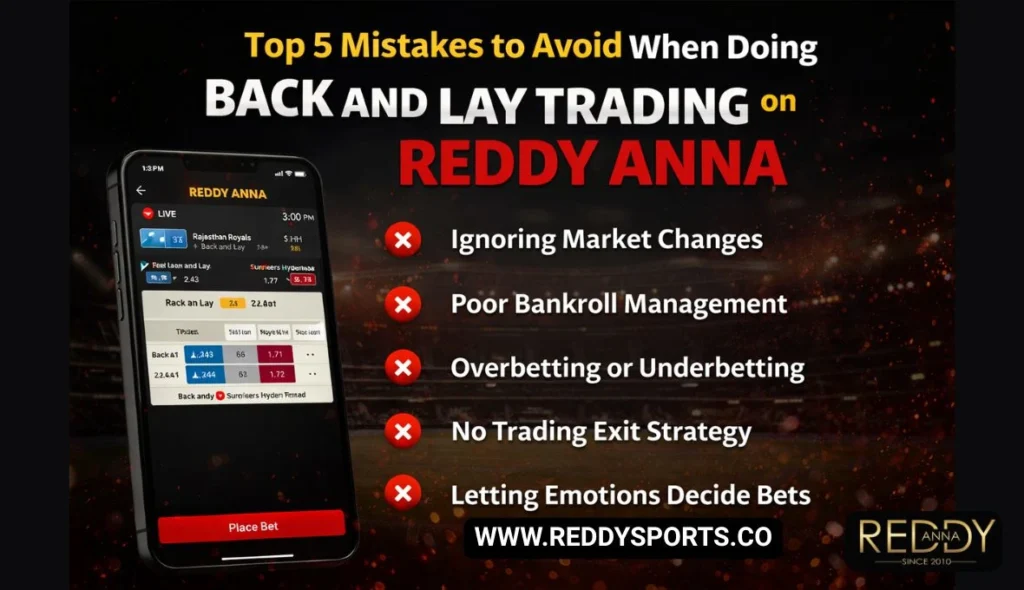
Back and lay trading has become increasingly popular among experienced cricket followers who prefer reading match situations rather than relying on pure chance. Unlike fixed-outcome approaches, back and lay trading allows users to respond to changing match conditions, odds movement, and momentum shifts—especially during live cricket.
On Reddy Anna, back and lay trading is widely used during high-liquidity matches such as international games, IPL, and major domestic tournaments. However, while the concept appears straightforward, many users make avoidable mistakes that reduce consistency over time.
This blog explains the top five mistakes to avoid when doing back and lay trading on Reddy Anna, focusing on market behavior, timing, and decision discipline—rather than shortcuts or unrealistic expectations.
Understanding Back and Lay Trading on Reddy Anna
Before discussing mistakes, it’s important to understand what back and lay trading actually involves on Reddy Anna.
- A back position means you are supporting a particular outcome to happen (for example, a team to win).
- A lay position means you are opposing that same outcome, expecting it not to happen.
The goal in trading is not necessarily to predict the final result, but to take advantage of odds movement during the match. Users often back at higher odds and lay later at lower odds (or vice versa), locking in value through timing rather than outcomes.
Because Reddy Anna provides live odds updates and fast market refresh, trading decisions are closely tied to match flow.
Mistake #1: Treating Back and Lay Trading Like Simple Betting
One of the most common mistakes users make is treating back and lay trading as normal pre-match betting. Many new traders place a back or lay position and then wait for the final result, completely ignoring odds movement in between.
Back and lay trading is process-driven, not result-driven. The entire concept revolves around entering and exiting positions at the right time. When users focus only on the final outcome, they miss the opportunity to manage risk or secure value earlier.
On Reddy Anna Book, live odds can shift significantly after:
- A wicket
- A big over
- A batting collapse
- Weather or pitch influence
Ignoring these moments and waiting passively is one of the fastest ways to lose consistency in trading.
Mistake #2: Entering Trades Without Understanding Match Context
Another major error is placing back or lay positions without fully understanding the match situation. Odds do not move randomly; they respond to real on-field factors.
Users often enter trades without considering:
- Pitch behavior
- Batting depth
- Required run rate vs wickets in hand
- Session or over phase
For example, laying a batting team simply because odds are low—without accounting for wickets in hand or set batters—can be risky. Similarly, backing a bowling side late in the innings without recognizing dew conditions or short boundaries can lead to poor outcomes.
On Reddy Anna, successful traders pay close attention to context, not just numbers on the screen.
Mistake #3: Over-Trading During Live Matches
Live trading is exciting, but it can also encourage excessive activity. One of the biggest mistakes users make on Reddy Anna is over-trading—entering too many back and lay positions within a short period.
Every trade carries exposure. When users place multiple overlapping trades without clear exit plans, they often lose track of:
- Total liability
- Open positions
- Market direction
Back and lay trading works best when users wait for high-clarity moments rather than reacting to every small odds fluctuation. Not every over or delivery presents a trading opportunity.
Disciplined traders understand that doing fewer, well-timed trades is more effective than constant market activity.
Mistake #4: Ignoring Exit Strategy Before Entering a Trade
Many users focus heavily on where to enter a trade but give little thought to how and when to exit. This is one of the most damaging mistakes in back and lay trading.
Before placing a back or lay position on Reddy Anna ID, users should already know:
- At what odds they will exit if the market moves favorably
- At what point they will reduce exposure if the market moves against them
Without a clear exit plan, traders often hesitate, hoping the market will “come back.” In fast-moving matches, this hesitation can quickly turn manageable exposure into unnecessary loss.
Professional trading is less about being right and more about managing exits efficiently.
Mistake #5: Letting Emotions Control Trading Decisions
Back and lay trading requires emotional control. Unfortunately, many users allow emotions to override logic—especially after a loss or missed opportunity.
Common emotional triggers include:
- Chasing losses after a bad trade
- Entering impulsive trades after a big wicket
- Holding losing positions due to hope
On Reddy Anna, where live markets update rapidly, emotional reactions can compound quickly. A single emotional decision often leads to a series of poor trades.
Successful traders treat each trade independently. They do not attempt to “recover” losses through rushed decisions.
Why Timing Matters More Than Prediction
One of the biggest misconceptions around back and lay trading is that it’s about predicting winners. In reality, it’s about timing entries and exits based on market behavior.
On Reddy Anna, odds movement is influenced by:
- Match momentum
- Public sentiment
- Liquidity levels
Understanding when markets overreact—and when they underreact—is a key skill. Many mistakes occur when users enter trades too late, after the market has already adjusted.
Patience is often more valuable than prediction accuracy.
The Role of Liquidity in Back and Lay Trading
Liquidity plays a crucial role in trading efficiency. High-liquidity matches allow smoother entry and exit, while low-liquidity markets can trap users in unfavorable positions.
Users on Reddy Anna often make the mistake of trading:
- Low-profile matches
- Early overs with limited market depth
- Unstable markets with wide odds gaps
High-profile matches provide better price movement and more reliable exits. Ignoring liquidity can turn even correct analysis into a difficult trade.
Understanding Liability vs Potential Return
Another technical mistake users make is misunderstanding liability, especially when laying outcomes. Lay positions expose users to higher potential loss compared to back positions.
On Reddy Anna, traders must clearly understand:
- Maximum liability on a lay trade
- How multiple trades add up in exposure
Failing to calculate liability accurately often leads to unexpected risk, especially during sudden momentum shifts.
Using Reddy Anna Tools Effectively
Reddy Anna provides real-time odds, fast updates, and clear market displays. However, tools are only useful when used correctly.
Many mistakes occur when users:
- Switch markets too frequently
- Ignore live commentary context
- React to odds without understanding why they moved
Using Reddy Anna effectively means combining market data with match understanding, not treating odds as isolated signals.
Why Fewer Trades Often Lead to Better Results
Experienced traders on Reddy Anna often trade less than beginners. This is not because they lack opportunities, but because they wait for high-probability situations.
Quality trades typically appear:
- After momentum-changing events
- During clear imbalance between odds and match reality
- When public sentiment overreacts
Avoiding unnecessary trades is one of the most underrated skills in back and lay trading.
Learning Curve: Why Mistakes Are Common Early On
Back and lay trading has a learning curve. Most users make mistakes early, especially when transitioning from traditional betting. The key is not avoiding mistakes entirely, but learning from them systematically.
Reviewing trades, understanding why an entry or exit failed, and adjusting approach over time is how consistency develops.
Final Thoughts
Back and lay trading on Reddy Anna offers a dynamic and analytical way to engage with live sports markets. However, success depends less on prediction and more on discipline, timing, and emotional control.
The top mistakes—treating trading like betting, ignoring context, over-trading, lacking exit plans, and emotional decision-making—are all avoidable with awareness and structured thinking.
For users who approach trading patiently and respect market behavior, back and lay trading becomes a skill-based activity rather than a reactive one. Understanding what not to do is often more valuable than chasing shortcuts.
 Get Reddybook ID Now